
✍️ K. M. Rajan Meemamsak
According to Maharshi Dayananda Saraswati, after Sri Rama, Sri Krishna, the Yogeshwara, was the greatest and most distinguished Mahapurusha the world had seen. His personality is not merely a matter of religious belief; rather, it serves as an inspiration for justice, yoga practice, courage, knowledge, duty, friendship, national welfare, and the protection of Dharma.
- Maharshi Dayananda Saraswati’s view of Sri Krishna
Maharshi Dayananda Saraswati gives a very clear assessment of Sri Krishna’s character in the eleventh Samullasa of Satyarth Prakash. He states:
«“The history of Sri Krishna in the Mahabharata is excellent. His qualities, actions and character are comparable to those of noble and trustworthy persons.”»
Maharshi further states that in the life of Sri Krishna, from his birth to his death as described in the Mahabharata, there are no immoral actions. He did not accept the faults later attributed to Krishna’s character through stories that developed in the Puranas.
Thus, from Maharshi Dayananda’s perspective, Sri Krishna is not merely a person to be worshipped as an incarnation of God; rather, he is a great and noble person whose qualities, actions and character are worthy of emulation.
- Yogeshwara Sri Krishna
The highest aspect of Sri Krishna’s personality can be seen in his role as a yogi and Karma Yogi. On the battlefield of Kurukshetra, Arjuna became overwhelmed by delusion and grief and wished to withdraw from his duty. Sri Krishna, however, did not teach him the path of escape. Instead, he taught him the path of knowledge, discrimination, self-control and the performance of duty.
In the Gita, he gives the principle of performing one’s duties without attachment:
«“Yogasthah kuru karmani sangam tyaktva Dhananjaya.”»
Meaning: “O Dhananjaya, established in Yoga, perform your duties while abandoning attachment.”
Sri Krishna’s Yoga is not a Yoga that requires one to abandon the world. It is the Yoga of maintaining self-control while fulfilling one’s duties. In his life, justice and spirituality, knowledge and action, peace and courage are wonderfully integrated.
- Sri Krishna as a Diplomat and Strategist
The Sri Krishna of the Mahabharata was not merely a warrior on the battlefield; he was also a highly capable diplomat and strategist. He understood circumstances, recognised the nature of individuals, and developed appropriate strategies for the welfare of the nation.
In the matter of Jarasandha, Sri Krishna analysed the situation and formulated a plan together with Bhima and Arjuna. In the Mahabharata, his words clearly demonstrate the relationship between justice, strength and victory.
Sri Krishna’s strategies were not for personal selfish interests; they were for the protection of Dharma and society.
He teaches us that strategy does not mean deception. It means understanding time, circumstances and objectives and taking decisions in accordance with Dharma.
- Sri Krishna as the Teacher of the Bhagavad Gita
One of Sri Krishna’s most famous contributions in history is his teaching of the Bhagavad Gita to Arjuna.
When Arjuna saw his own relatives on the battlefield of Kurukshetra, he became overwhelmed with grief. Sri Krishna then taught him about self-knowledge, the principle of Karma, Jnana Yoga, Karma Yoga, Dhyana Yoga, control of the senses, equanimity, one’s own duty, renunciation and detachment.
The central message of the Gita guides human beings from delusion towards discrimination and from inactivity towards the performance of duty.
Therefore, Sri Krishna was not merely Arjuna’s charioteer; he was also his guide and spiritual teacher.
- Sri Krishna as a Worshipper of God
From the Vedic perspective, an important principle is that God is One and that human beings should worship the Supreme God.
In the Mahabharata, Sri Krishna is seen on many occasions respecting Dharma, duties and the traditions of sages. He did not live as though he were above the duties of human life.
In the Gita too, Yajna, self-discipline, austerity, knowledge and duty are presented as essential parts of life.
Therefore, from the Vedic perspective, rather than understanding Sri Krishna primarily as an incarnation of God, it is more reasonable to understand him as a great person possessing profound knowledge of Vidya, Yoga and Dharma.
- Sri Krishna as a Cowherd
While discussing Sri Krishna’s childhood, one point should be kept in mind. The Mahabharata does mention Krishna’s association with cowherds and his life as a protector of cattle. However, it would not be correct to completely merge the extensive childhood stories that developed later in the Puranas with the historical portrayal of Krishna in the Mahabharata.
Here, Krishna’s role as a cowherd should be understood as his association with cattle protection and rural life.
Cattle and agriculture were important foundations of the economic and social structure of Indian society. Therefore, the protection of cattle wealth and rural communities can also be understood as part of Krishna’s broader social responsibility.
- Sri Krishna as the Bearer of the Sudarshana Chakra
In the Mahabharata, Sri Krishna is a great hero and a master of warfare and strategy. His principal weapon is the Sudarshana Chakra. Various instances of Krishna as a wielder of the Chakra are found in the Mahabharata.
However, Krishna’s greatness does not lie merely in carrying a weapon. The purpose of a weapon is not aggression; it is the protection of Dharma and the innocent.
Thus, Sri Krishna as the bearer of the Chakra teaches us that strength must always be accompanied by responsibility.
- Sri Krishna Who Defeated Kamsa
The killing of Kamsa is mentioned in the Mahabharata as an important event in Sri Krishna’s life. In the Sabha Parva, Krishna himself speaks about the killing of Kamsa and his followers.
Kamsa was an oppressive ruler. His end was not merely the killing of an individual; it symbolised the struggle against oppression.
The form of Krishna who defeated Kamsa teaches us that when injustice gains power, a righteous person should not remain silent.
- Sri Krishna as the Messenger of Peace
One of the most important and sometimes overlooked aspects of Sri Krishna’s personality is his effort to establish peace.
In the Udyoga Parva of the Mahabharata, Krishna makes efforts to prevent war between the Pandavas and the Kauravas. The Pandavas put forward a very limited demand—even five villages would have been sufficient to avoid war.
The Mahabharata makes it clear that Krishna desired the welfare of both sides and gave priority to peace.
Therefore, viewing Sri Krishna merely as a person who encouraged war is an injustice to his personality. Krishna sought peace first and accepted war only as a last resort.
- Sri Krishna as an Ideal Person
To regard Sri Krishna as an ideal does not mean merely remembering his name; it means incorporating his qualities into our own lives.
From Sri Krishna we can learn:
- Yoga — Control the mind and senses.
- Knowledge — Understand circumstances with discrimination and wisdom.
- Action — Never withdraw from one’s duties.
- Strategy — Adopt strategies that are in accordance with Dharma.
- Courage — Never bow before injustice.
- Peace — Make every possible effort for peace before resorting to war.
- Friendship — Stand by a friend during times of difficulty.
- National Duty — Give greater importance to the welfare of society than to personal comfort.
- Sri Krishna as an Ideal Friend
The friendship between Sri Krishna and Arjuna is one of the greatest friendships described in the Mahabharata.
Krishna was Arjuna’s friend, guide and charioteer. At a decisive moment in Arjuna’s life, he did not abandon him.
The Udyoga Parva also provides clear evidence of the mutual trust and deep bond between Krishna and Arjuna. The Mahabharata describes their relationship as so close that it is difficult to separate Krishna from Arjuna.
True friendship does not mean merely being together in times of happiness. It means standing by a friend during difficulties and, when necessary, showing the friend the path of truth and duty.
- Sri Krishna as a Devoted Householder
While discussing Sri Krishna’s family life, the Mahabharata should also be taken as the basis.
The Mahabharata mentions Krishna’s marriage and his life as a householder. Presenting him merely as a character in romantic stories limits and distorts his historical personality.
Fulfilling responsibilities towards one’s wife, family and society was considered an important part of the traditional Indian system of Dharma.
- The Wonderful Combination of Strength and Peace
A remarkable combination can be seen in Sri Krishna’s personality.
He was a messenger of peace as well as a master strategist in warfare.
He was a yogi as well as a statesman.
He was a friend as well as a guide.
He was a teacher of Dharma as well as a courageous hero who took up arms when necessary to destroy oppression.
It is this harmonious combination of qualities that makes Sri Krishna one of the greatest personalities of the Mahabharata.
- Maharshi Dayananda’s Vision of Sri Krishna
Maharshi Dayananda evaluated Sri Krishna not on the basis of blind devotion, but on the basis of history, character, qualities and actions.
His conclusion was that Sri Krishna’s character in the Mahabharata was excellent and that his qualities, actions and character were comparable to those of noble and trustworthy persons.
From this perspective, more important than merely worshipping Krishna is to incorporate Krishna’s qualities into our own lives.
If we learn Yoga from Krishna, accept the sense of duty that he taught Arjuna, incorporate his wisdom, friendship and efforts for peace into our lives, and gain the courage to stand against injustice, then and only then will the celebration of Krishna Janmashtami become truly meaningful.
(Courtesy : Maharshi Dayananda Saraswathi‘s literature and Mahabharatha))
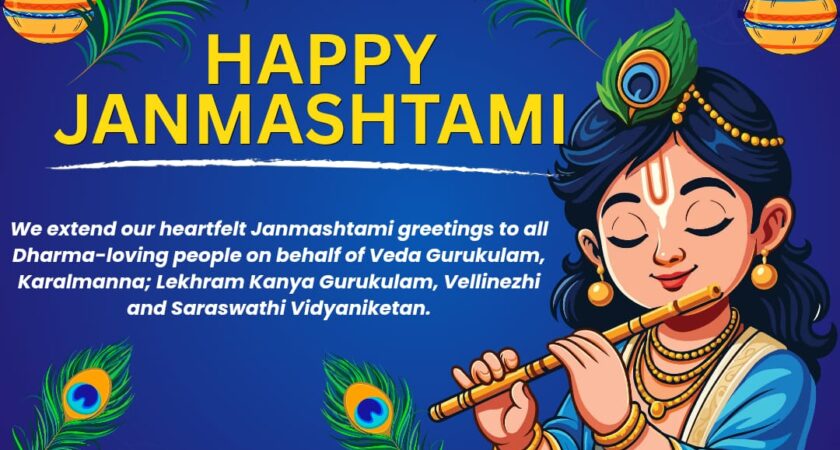
We extend our heartfelt Janmashtami greetings to all Dharma-loving people on behalf of Veda Gurukulam, Karalmanna; Lekhram Kanya Gurukulam, Vellinezhi; and Saraswathi Vidyaniketan.
On the occasion of Janmashtami, you can participate in the special Agnihotra being conducted at Veda Gurukulam today at 6:30 AM by clicking the link given below:
“Watch the Special Agnihotra – Veda Gurukulam” (https://reference-url-citation.invalid/0)
🙏
K. M. Rajan Meemamsak
Arya Pracharak & Adhishtata
Veda Gurukulam, Karalmanna & Lekhram Kanya Gurukulam, Vellinezhi